Cooking Guide
Camp Stoves & Off-Grid Cooking
Keep meals in the plan when the power goes out. Start with food you can eat without cooking, then build an outdoor cooking option around your household. Ready.gov recommends staples that need no refrigeration, cooking or special preparation.
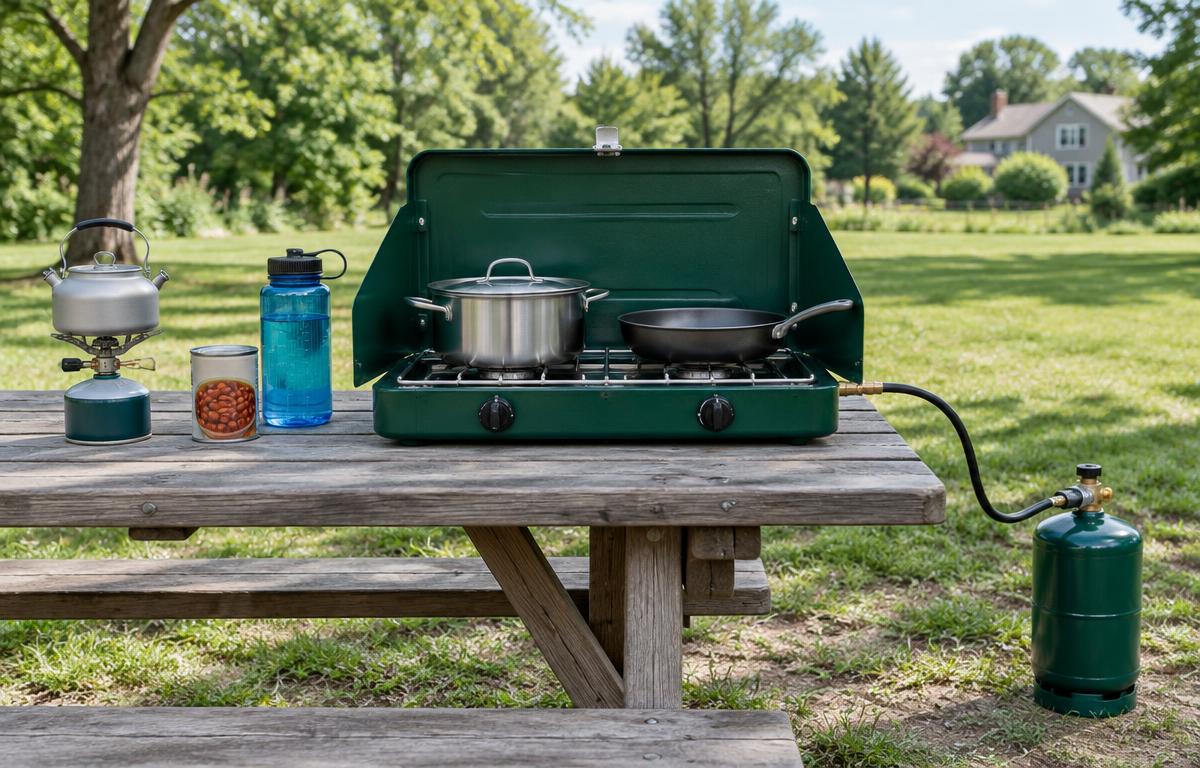
A cooking plan, not just a stove
Our suggested layers are a no-cook pantry, an outdoor stove, and a backup method suited to your space. Keep ready-to-eat foods in the first layer, including a manual can opener and utensils.
No safe outdoor cooking space? Make no-cook food the foundation rather than moving a camp stove inside. Ready.gov limits camp stoves and charcoal grills to outdoor use.
Camp stove & fuel choices
Use these questions to compare equipment: are you cooking for one person or a household, boiling water or preparing full meals, carrying the stove or leaving it at home? Combustion camp stoves belong outdoors.
| System | Why consider it? | Planning trade-off |
|---|---|---|
| Propane camp stove | A household/base-camp option to evaluate. Propane performs better in cold than butane or isobutane in MSR’s LPG comparison. | Pure propane requires a heavier pressure-rated container. Check the stove’s approved cylinder and connection. |
| Isobutane / propane canister stove | A portable, low-maintenance option; MSR describes canister stoves as lighter and more compact than liquid-fuel counterparts. | Canister pressure drops in cold weather. Match the fuel blend and stove to your conditions; don’t treat a fuel’s boiling point as a guaranteed operating limit. |
| Butane or dual-fuel stove | A comparison option if its approved fuels fit your supply plan. Use only the fuels and connections specified for that model. | Butane is not the cold-weather equivalent of propane. “Dual fuel” does not authorize arbitrary adapters or fuel substitutions. |
| Liquid-fuel stove | Worth evaluating for cold conditions; MSR generally favors liquid fuel there. | More maintenance and model-specific operation. Include practice with the manufacturer’s filling, priming and shutdown procedure. |
Our household shopping questions: will your actual pots fit without crowding, do you need two burners, and can you prepare the meals you stock? For a carried kit, ask whether a compact stove meets the meal plan. Test the setup using the appliance’s instructions before depending on it.
What two practical setups look like
Editorial examples, not affiliate offers or hands-on reviews. We do not currently have a direct stove partner.
Household: a two-burner propane setup
Coleman’s Classic 2-Burner is a concrete example of this format. Our sample meal is canned soup with a second pot for another household dish; commercially canned food can also be eaten without warming. The planning questions are pot fit, approved fuel and connections, and a safe outdoor location—not just burner output. Use the instructions for the actual stove; the 5428A manual cited elsewhere is not the Classic’s manual.
Carried kit: a compact canister stove
MSR’s PocketRocket 2 illustrates the compact canister-stove format, with folding pot supports. Our get-home meal example is a packaged meal prepared according to its label, using the stove’s approved pot and fuel. Compare that setup with ready-to-eat food before adding cooking to the bag; the no-cook option needs no stove, and canister pressure decreases in cold conditions.
Wood, charcoal & solar cooking
A grill can be one part of an outdoor plan, but it is not an indoor substitute. Never burn charcoal indoors—even embers give off carbon monoxide.
Wood fire, rocket stove or charcoal grill
Our suggested role is an additional outdoor method where permitted, rather than your only option. Check current local fire orders before relying on wood or charcoal. Inyo National Forest’s Stage 1 description, for example, prohibits dispersed ground fires burning either fuel. A stove allowance elsewhere is not universal permission during a burn ban.
Our backup question: what will you eat if the current fire order rules out this method? Keep a no-cook meal available rather than making wood or charcoal the only way to prepare dinner.
Solar oven
Solar cooking uses direct sunlight to heat food and water. That makes it a supplementary option in our plan: retain ready-to-eat meals for times when sunlight is unavailable. This guide does not promise a cooking time or a safe finished-food temperature from sunlight alone.
Our planning rule: do not schedule the evening meal around solar heat after sunset. Direct sunlight is the energy source; keep a no-cook or another suitable cooking option for that meal.
Battery-powered cooking
For our electric-cooking plan, separate two questions: can the power supply run the appliance, and how much energy will a meal use? Use actual appliance specifications in the energy calculation. Our compatibility checklist is the appliance’s required voltage and rated draw against the supply’s continuous output and manufacturer instructions. See the Power Guide for electrical sizing and its sourced formulas.
Worked energy example—not a runtime promise
Assumed appliance draw: 1,000 W. Assumed use: 15 minutes.
Energy = watts × minutes ÷ 60
1,000 × 15 ÷ 60 = 250 Wh
That arithmetic is appliance-side energy only; it does not establish usable battery capacity, conversion losses, surge compatibility or meals per charge. Use actual specifications and the Power Guide before sizing a system.
Battery-powered cooking is not the same as bringing a fuel generator indoors. Keep any combustion source outside and away from openings.
Outdoor setup & fuel safety
Outdoor fuel stoves stay outdoors
Never use a portable gas camp stove indoors. Never burn charcoal indoors.
A garage, camper or tent is not an outdoor cooking location; do not position fuel-burning equipment outside near an open window or window air conditioner. An open door is not an exception to the indoor prohibition.
- Use your model’s clearance rules. Coleman’s 5428A specifies 12 inches at the sides and 48 inches above combustible materials; those numbers apply to that model, not every stove or nearby window.
- Keep the right fuel with the right appliance. Make the manual and fuel-container label part of your kit; follow their connection, filling, shutdown and storage procedures.
- Disposable means disposable. Never refill disposable propane cylinders.
- Plan cylinder storage. Coleman directs refillable propane tanks to outdoor, well-ventilated storage. Follow the actual cylinder label and applicable local requirements.
Food safety during an outage
An unopened refrigerator keeps food cold for about four hours. Use a refrigerator thermometer rather than guessing.
Ready.gov says to discard perishable food such as meat, poultry, fish, eggs and leftovers after two hours or more above 40°F. Discard food that contacted contaminated floodwater.
A closed full freezer holds its temperature for approximately 48 hours; a half-full freezer, approximately 24 hours. These are unopened-freezer estimates, not a guarantee about a particular food.
For prepared perishable food, USDA’s refrigeration limit is two hours—or one hour above 90°F. Include cold storage in the meal plan rather than cooking more than you can keep safely.
A simple meal plan
For a no-cook meal, our suggested starting point is commercially canned food plus ready-to-eat pantry items that fit your household’s diet. Commercially canned food can be eaten without warming. Keep preparation and eating utensils clean.
- No-cook backup: choose ready-to-eat pantry foods, a manual opener and utensils that fit dietary needs.
- Heat-and-eat meal: warm commercially canned food outdoors if you have a suitable cooking setup; it is also an option without warming.
- Cook-from-dry meal: our planning checklist is the package’s water needs, cooking instructions, fuel method and cleanup—not just how many servings the bag claims. Keep the no-cook layer as the fallback.
Practice one stocked meal
Our suggested test is one meal from your actual pantry, with the equipment you intend to use. Treat it as a planning exercise—not a fuel-runtime guarantee. Keep the ready-to-eat layer in the plan.
- Choose the meal and its fallback. Our worksheet starts with the package’s preparation directions and a ready-to-eat alternative that needs no cooking.
- Set up the real equipment. Check the actual model’s manual, approved fuel and clearances; fuel camp stoves and charcoal stay outdoors.
- Record what the meal uses. Our worksheet has spaces for preparation water, fuel used, cooking time and cleanup supplies. For electric cooking, record appliance watts and minutes, then calculate Wh = watts × minutes ÷ 60; this is appliance-side energy, not battery runtime.
- Account for cleanup and leftovers. Keep utensils clean and refrigerate prepared perishable food within two hours, or one hour above 90°F.
- Review the plan. Our final questions: did the meal suit the household, which supplies need replenishing, and what would you eat if cooking were unavailable? Retain the no-cook pantry rather than relying on the practice meal alone.
Gear & next steps
Affiliate disclosure: purchases through partner links may earn PrepFindr a commission. We have not identified a direct stove partner in our current catalog; the partner searches below cover supporting food and power, not endorsed stove models.
Food contents and preparation needs vary. A power-station listing is not a claim that it will run your chosen cooking appliance.