
Homestead Guide · Livestock
Raising Meat on Your Land: Grazing, Hay & Feed Planner
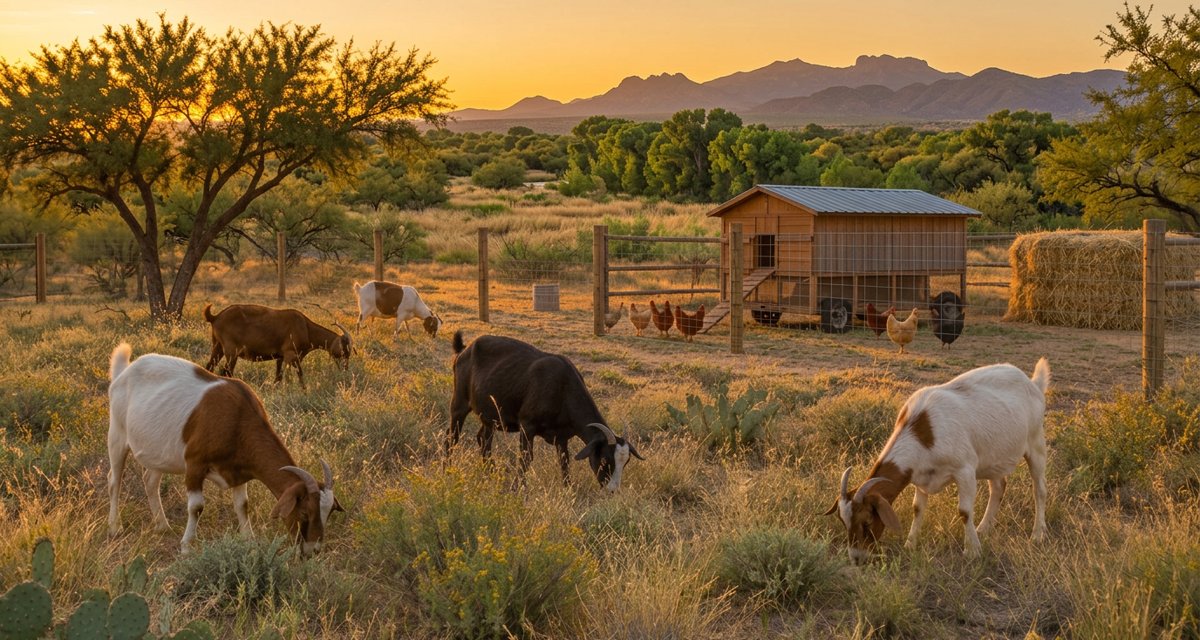
How many animals can your land feed, how much hay and grain will you still buy, and how much meat comes home? The answer depends mostly on when your rain falls, what kind of ground you have, and which animals you pick.
How many animals can an acre support? The short answer
It ranges from about 1 cow-calf pair per 2–3 acres of good humid pasture to 1 pair per 50–100+ acres of semidesert grassland. Meat goats and sheep need roughly one-fifth to one-sixth of that. Pigs and poultry don't run on grass, so land mostly limits their numbers by how much the ground can take before it turns to bare dirt.
Free interactive tool
Livestock Production Calculator
What this calculator returns
- Safe forage per year and animal-unit months (AUM)
- Overstocked or within capacity
- Month-by-month forage gaps
- Tons of hay to buy
- Pounds of grain or concentrate
- Take-home meat by species
- Livestock water per day and per year
- Soil-damage warnings for pigs and poultry
Livestock Production Calculator
How much grazing your land supplies, how much hay and feed you still need to buy, and how much meat comes home. It opens with a sample 40-acre monsoon grassland plan; change any number. These are conservative planning estimates, not a guarantee.
Saved plans
Plans are saved in this browser only. Save one to compare different herds or land setups.
1. Climate & forage
Rain: 10–20 in, mostly July–September thunderstorms; May–June dry
Upland yield: 600 lb dry forage/acre/yr (300–1,000 range)
Safe grazing use: 35% of what grows
Green months: Apr, Jul, Aug, Sep
Grass greens with the monsoon. Expect a hard feed gap in May and June, before the rains.
2. Land (acres by type)
3. Animals
Breeding stock stay all year. Add their offspring as separate rows (kids, lambs, steers) for the months you raise them.
Grazer · ~130 lb · eats 3.8% of body weight/day · 85% forage · Browse helps. Her kids go in a Kid row
Not a grazer; pasture offsets part of the ration · ~160 lb · eats 4.0% of body weight/day · 15% forage · harvested at 260 lb, 52% take-home · Pasture does not replace the grain ration
Not a grazer; pasture offsets part of the ration · ~4 lb · eats 5.5% of body weight/day · 15% forage · harvested at 6 lb, 67% take-home
Overstocked: herd needs 218% of safe forage
Reduce head count, add land, or plan to buy the difference as hay every year.
Safe forage / yr
7,224
lb dry matter
Animal-unit months
9.3
AUM
Year-round capacity
0.76
cow-size animal units
Hay to buy
5.8
tons (incl. 15% waste)
Grain / concentrate
4,734
lb (2.4 tons)
Take-home meat
431
lb per year
Water, peak month
24
gal/day for livestock
Water, full year
6,779
gal
Estimate — the math: Σ(acres × yield × safe use) × 0.8 drought = 7,224 lb · ÷ 780 = 9.3 AUM · ÷ (26 × 365) = 0.76 AU year-round · herd forage = head × weight × intake × forage share × days = 15,746 lb · hay = monthly shortfalls 8,899 lb × 1.15 ÷ 1750 = 5.8 tons
Share these results
The image shows the key numbers and the month-by-month forage chart. The link opens this exact plan so others can adjust it.
Forage available vs herd demand, by month
Green: standing forage (new growth plus leftover grass, which loses about 8% a month to weather). Red: herd demand. Amber: months you feed hay — Jan, Feb, Mar, Apr, May, Jun, Nov, Dec.
| Month | Available | Demand | Shortfall |
|---|---|---|---|
| Jan | 0 | 1,302 | 1,302 |
| Feb | 0 | 1,176 | 1,176 |
| Mar | 361 | 1,302 | 940 |
| Apr | 722 | 1,357 | 634 |
| May | 0 | 1,396 | 1,396 |
| Jun | 0 | 1,317 | 1,317 |
| Jul | 2,167 | 1,361 | 0 |
| Aug | 3,270 | 1,361 | 0 |
| Sep | 2,840 | 1,312 | 0 |
| Oct | 1,767 | 1,302 | 0 |
| Nov | 428 | 1,260 | 832 |
| Dec | 0 | 1,302 | 1,302 |
Take-home meat by species
- Pork270 lb
- Chicken161 lb
A common target is 150–200 lb of take-home meat per adult per year: 300–400 lb for your household. You're at 144% of the low end.
This land could carry about 0 cow-calf pairs OR 4 meat goat does OR 3 meat ewes year-round on forage alone.
Creek bottoms are the most productive and most fragile ground. Graze them briefly and rest them, or fence them off.
Pigs need a complete grain ration. Pasture, scraps and mast only trim the feed bill.
Monsoon grassland: May and June are the leanest months. Have hay on hand before the dry spring, not after.
Carrying capacity follows the standard animal-unit method: 1 animal unit is a 1,000 lb cow eating 26 lb of dry forage a day. Safe use leaves most of the grass standing to protect roots and soil. Regional yields are typical ranges, and your own ground can differ a lot. Your county extension office or NRCS can give site-specific numbers.
Free interactive tool
Garden Production Calculator
What this calculator returns
- Household daily and annual calorie demand
- Garden calories by climate zone or plant list
- Egg and livestock calories
- Surplus or deficit against demand
- Protein, vitamin and mineral check
- Daily water cost of garden and livestock
Food Production & Calorie Security Calculator
Estimate whether your garden and livestock can cover your household's daily calories — and how much water that food system burns to stay alive. Household demand counts each person by age and sex.
Household
Frost-free growing window: 175 days
Photosynthetic Production
Per-group figures are typical yield × calories per pound, then adjusted for your region.
Household (people in each group)
Numbers are kcal per person per day at the "active" level, because a long emergency usually means more physical work — hauling water, cutting wood, gardening, repairs. Adults over 50 need a little less, so this runs slightly high on purpose.
Livestock Production (head count)
Eggs: ≈ 0 eggs/day × 72 kcal = 0 kcal/day (250 eggs/hen/yr × 1 for your region's day length and heat). Meat chickens, turkeys and rabbits are yearly meat averaged per day; a breeding doe counts her litters.
A laying hen in good conditions lays about 250 eggs a year at 72 kcal per large egg. Laying slows in winter and after the second year.
⚠️ Calorie Deficit: -5,400 kcal/day
Your current system does not cover household demand. Expand garden area, add calorie-dense staples, or close the gap with stored food.
Daily Household Demand
5,400
kcal/day (1,971,000 kcal/yr)
Estimated Self-Production
0
kcal/day
Production Split
0% / 0%
crops / livestock
Estimate — the math: household (1 × 2,400 + 1 × 3,000) = 5,400 kcal/day · garden: Σ(sq ft × kcal/sq ft) × 1 region ÷ 365 = 0 kcal/day · demand × 365 = 1,971,000 kcal/year · production − demand = -5,400 kcal/day
Nutrient Check — Daily Needs From What You Produce
Compares the vitamins and minerals in your harvest with your household's recommended daily amounts.
Add garden space or animals above to see your nutrient coverage.
Green is met, amber is 50–99%, red is under half. Figures are for fresh food; storing, drying and cooking lose much of the vitamin C and some vitamin A. Vitamin B12 comes only from animal foods like eggs and meat. Vitamin D comes mostly from sunlight, so it isn't counted. This is a planning estimate, not medical advice.
🔒 Intertwined Resource Cost — Water Audit
Garden Water
0
gal/day
Livestock Water
0
gal/day
Total Ag Demand
0
gal/day
This is agricultural water only — add it to your household drinking, cooking, and hygiene demand from the water guide calculator. Livestock water baselines scale with heat stress.
Strategic Philosophy — Regional Advice
You have a highly stable, standard agricultural baseline. Your main constraint is a rigid 5-to-6 month growing season. You must focus your photosynthetic strategy on heavy food preservation (canning/dehydrating) during the harvest peak to carry your household's calorie needs through the winter freeze.
Whatever your land can't cover is the gap to fill with stored food. The food storage guide has a calculator for that.
How the math works: animal units
Ranchers measure grazing in animal units. One animal unit is a 1,000 lb cow eating about 26 lb of dry forage a day. One animal-unit month (AUM) is what she eats in a month, about 780 lb. The planner adds up the dry forage your land grows, keeps only the share that's safe to graze, trims it for drought, and divides by what your animals eat.
Safe grazing matters most. On dry rangeland, taking more than about a third of each year's growth weakens the grass, and next year's crop shrinks. The planner never lets you count all of the grass.
Why monsoon grassland isn't Mediterranean
Both are called "dry," but they are opposites. Monsoon grasslands in southeast Arizona and southwest New Mexico green up with July–September thunderstorms, and May–June is the hardest stretch. Mediterranean climates like California grow grass through winter and spring, and it dies in summer. The same acreage needs hay in completely different months, which is why the planner asks when your rain falls.
Leftover dry grass still feeds animals after the growing season, but it loses value to weather and trampling and runs low in protein. Growing and nursing animals often need a protein supplement on dormant range.
Choosing animals
Meat goats
Browsers that eat brush and weeds cattle skip. A good fit for shrubby, dry ground. They need tight fencing.
Sheep
Grazers that prefer grass and forbs. Easy to handle, but they do poorly on brushy land and need predator protection.
Beef cattle
The most meat per head, but one cow-calf pair needs a lot of land in dry country, and around 15–18 gallons of water a day.
Pigs
Fast growers that turn grain and scraps into pork. Pasture trims the feed bill but never replaces the grain ration.
Broilers & turkeys
The quickest meat from the least land. Nearly all of their feed is bought, and moving pens often keeps the ground healthy.
Ducks & geese
Geese are the closest thing to a grazing bird. Ducks forage insects and greens but still need a ration.
Rabbits
Quiet and small, with very lean meat. Pasture tractors moved daily cut the pellet bill roughly in half.
Water comes first
In dry country, water limits a herd sooner than grass does. A beef cow drinks 10–20 gallons a day, more in heat. The planner totals livestock water so you can add it to your household numbers in the water guide.
Frequently Asked Questions
- How many acres do I need per goat?
- On humid improved pasture, roughly 6–8 goats per acre is a common starting point. On semidesert grassland it can take 5–15 acres per goat. Use the planner with your region and land type for a site-specific estimate.
- How much hay does a cow need for winter?
- A 1,100 lb cow eats about 25–28 lb of dry forage a day, roughly 1 ton of hay a month including waste. Multiply by the months with no grazing in your region.
- Can pigs live on pasture alone?
- No. Pigs aren't ruminants and can't digest grass well. Pasture, scraps and nuts reduce the feed bill, but pigs still need a complete grain ration to grow and stay healthy.
- How much meat does a family need per year?
- A common planning target is 150–200 lb of take-home meat per adult per year, close to current U.S. average consumption.
Sources
These are the published documents behind the thresholds on this page. We quote them rather than linking out — search the document name and publisher to read the current edition yourself, and follow that edition if it differs from what you read here.
USDA Natural Resources Conservation Service, National Range and Pasture Handbook
1 animal unit = 1,000 lb cow at ~26 lb forage dry matter per day; AUM definition and animal-unit equivalents.
University of Arizona Cooperative Extension, Grazing utilization guidelines for arid and semiarid rangelands
Graze 30–40% of current-year growth on dry rangeland.
USDA / University Extension Publications, Water Requirements of Livestock
Daily water per head by species, rising with heat.
Cooperative Extension Services (Iowa State, Colorado State, and others), Vegetable Garden Yields and Planning Guides
Published per-square-foot yield ranges are the basis for the garden production estimates.
USDA Economic Research Service, Food Availability (Per Capita) Data System
U.S. per-capita red meat and poultry availability used for the per-adult meat target.