August 25, 2026
Knock Out Nine, Black Out America: 308 Million Dead.
A coordinated attack on just 9 critical substations could black out the U.S. for 18 months or longer. Here’s the real grid vulnerability—and how to prepare for long-duration failure.
Nine Substations From Darkness: The Grid Vulnerability That Could Black Out America for 18 Months
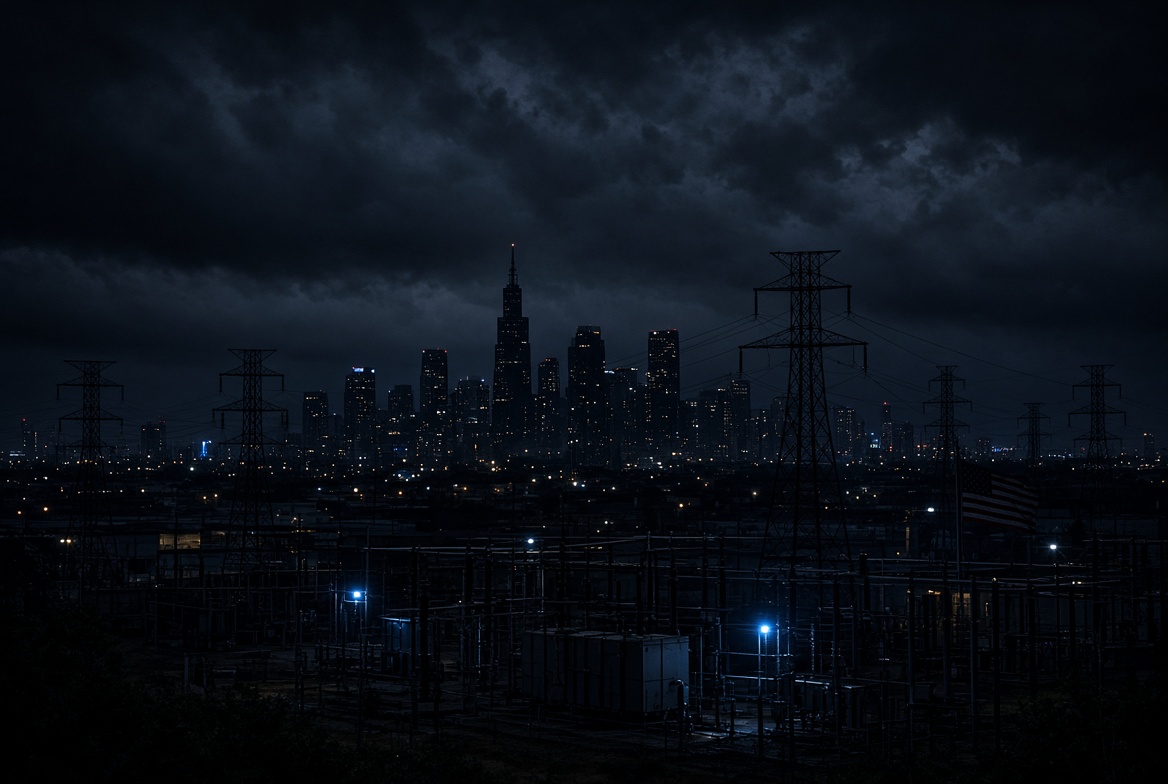
A coordinated attack on just nine critical substations could plunge the entire United States into darkness for 18 months or longer. That is the stark warning from former Federal Energy Regulatory Commission Chairman Jon Wellinghoff, highlighted in recent reporting. The U.S. grid—actually three largely separate interconnections—contains single points of failure that are surprisingly easy to identify and strike.
This is not abstract theory. Physical attacks have already tested the system. In 2013, gunmen fired more than 100 rounds into Pacific Gas & Electric’s Metcalf substation near San Jose, destroying 17 transformers. The station remained offline for nearly a month even while the rest of the grid still had power. No one was ever arrested.
Wellinghoff’s subsequent analysis showed that disabling a handful of the most critical substations—roughly three in each major interconnection—could cascade into a nationwide blackout. A small number of high-voltage nodes carry outsize load.
Cyber threats are evolving just as quickly. In July 2026, Iran-linked hackers (reportedly tied to groups affiliated with the Islamic Revolutionary Guard Corps) successfully shut down a small-scale power plant in the United Kingdom for four days. The UK government confirmed the incident affected a limited generator and posed no risk to the wider energy system, but it prompted briefings to energy CEOs and fresh guidance from the National Cyber Security Centre. It marked a clear escalation: a disruptive, real-world effect on generation infrastructure by a state-linked actor.
The United States faces the same dual threat environment. Physical sabotage of transformers and substations remains a low-tech, high-impact option. Cyber intrusions targeting operational technology could achieve similar results at greater scale and distance. Aging equipment compounds both risks. More than three-quarters of distribution transformers already exceed their design life. Large power transformers—custom-built giants weighing hundreds of tons—now carry average lead times of roughly 128 weeks, with some specialized units stretching to four or five years.
There is no ready national stockpile.
Gary Shows What Prolonged Darkness Looks Like
Even without an attack, recovery can drag. In mid-August 2026 a derecho with near-100 mph winds tore through northwest Indiana. Nearly two weeks later, thousands of customers in Gary were still without power. Trees had crushed lines, poles were destroyed, and substations needed repairs.
Residents dealt with spoiled food, closed businesses, and rising frustration while crews worked through extensive damage. The episode is a live illustration of how long restoration takes when the system is simply battered by weather—let alone when large transformers themselves are destroyed or control systems compromised.
What Prepared People Should Take Away
The grid is a complex, aging machine with limited spare parts and multi-year replacement timelines. Officials and industry groups continue to study physical and cyber vectors, hold hearings, and refine standards, yet the fundamental vulnerabilities persist.
For those focused on emergency preparedness and sustainability, the implication is straightforward: plan for the possibility that the grid does not recover for a very long time—measured in many months to well over a year. Short-term kits and a few weeks of supplies are useful starting points, but they are inadequate for an 18-month scenario.
Realistic long-duration readiness looks like this:
Power that can last: Prioritize renewable systems (solar with substantial battery storage) that do not depend on finite fuel. Generators and stored fuel become short- to medium-term bridges at best. Low-tech backups (manual tools, alternative cooking/heating methods) remain essential.
Food and water measured in years, not months: Deep food storage (properly rotated freeze-dried, dehydrated, and shelf-stable supplies) plus the ability to produce more through gardening, food preservation, and community sharing. Reliable long-term water sources and treatment methods are non-negotiable.
Skills for sustained self-reliance: First aid and trauma care, sanitation, basic repairs, food production, and security awareness that can be maintained over many months.
Community as force multiplier: Strong neighborhood or mutual-aid networks become far more important than any single household stockpile when recovery stretches into the better part of a year or longer. Isolation is a liability.
In a true long-duration outage—whether from sabotage, cyber action, or extreme weather—you and your community become the primary responders for an extended period. The nine-substation scenario, the Metcalf precedent, the recent UK cyber incident, and Gary’s ongoing recovery all point to the same conclusion: resilience that can endure many months must be built long before the lights go out.
What do you think a prolonged national power outage would look like. Day by day, week by week, month by month. When do you think society starts bending, then breaking down?
Are we truly nine meals from Anarchy?
Liked this? Get the next one in your inbox.
One email when we publish a new guide or review. Unsubscribe anytime.
We'll never share your email. Unsubscribe anytime.